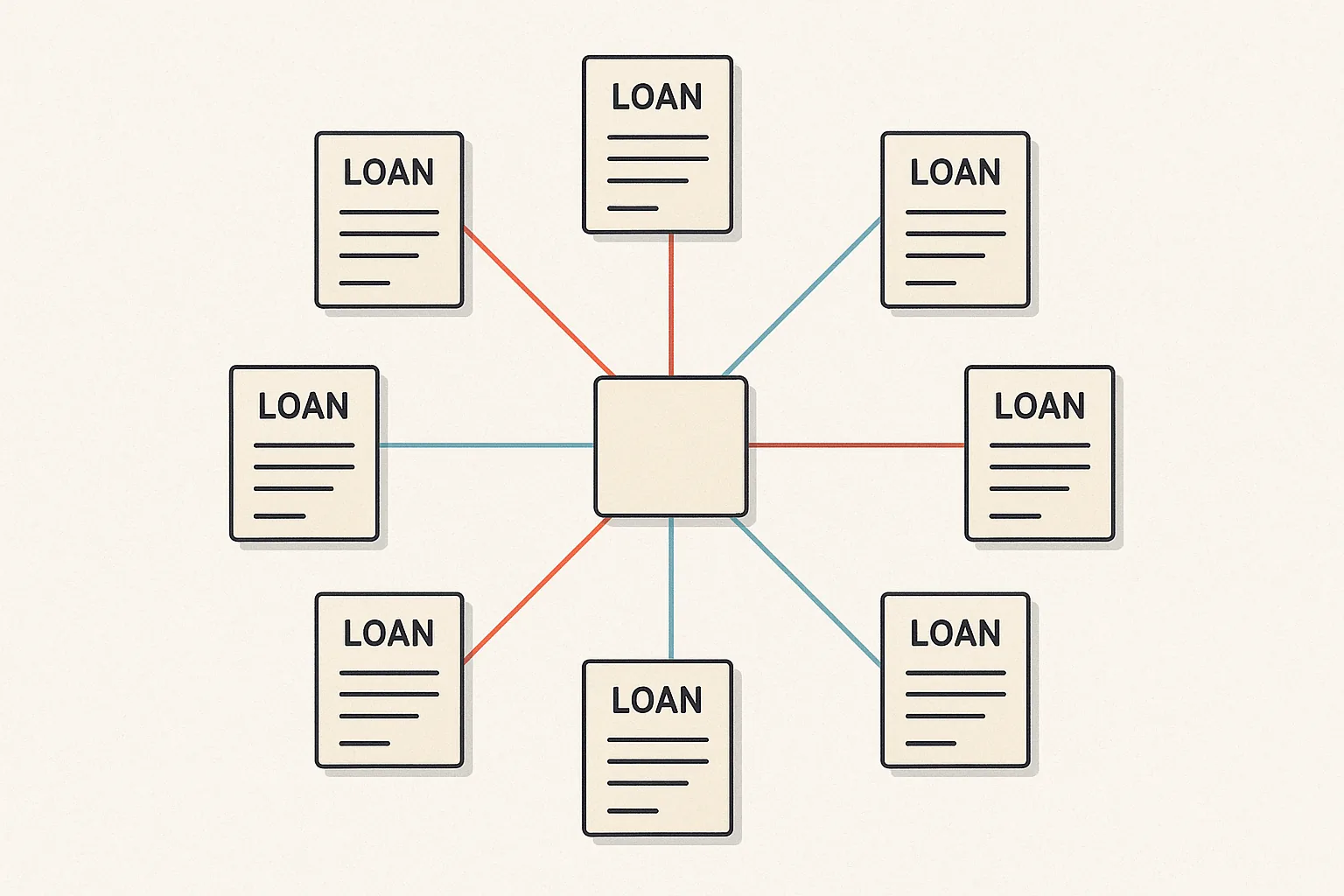
P2P lending in Switzerland lets individuals fund loans to consumers, SMEs, real-estate projects or unpaid invoices through an online platform, in exchange for interest. It is not a bank deposit, and it is not covered by deposit insurance. Before putting money into any Swiss lending platform, it helps to understand which model you are actually using, what oversight applies, and where the returns you see advertised really come from.
This guide walks through the main Swiss P2P and crowdlending models, the checks worth doing before you invest, what drives realistic returns, the risks that matter most, and a sensible way to start small. Use our risk screener alongside this article if you are evaluating a specific platform.
How Swiss P2P lending models work
“P2P lending” is used loosely in Switzerland to cover several distinct structures. They differ in who borrows, how the platform is regulated, and how you get repaid if something goes wrong. Grouping them together hides real differences in risk.
Consumer P2P lending connects private investors to individual borrowers taking personal loans. In Switzerland this activity sits close to the Swiss Consumer Credit Act (KKG), which governs affordability checks and disclosure for consumer credit. Platforms structuring these loans typically work with a partner bank that formally issues the loan, since only licensed banks may accept repayable funds from the public on a commercial scale under Swiss banking law.
SME crowdlending channels investor money to small and medium-sized businesses, often for working capital or expansion. Terms are usually shorter than real-estate loans and pricing reflects business credit risk rather than consumer credit risk. Underwriting quality varies a lot between platforms, and business defaults can be lumpier than consumer defaults because exposure per loan is larger.
Real-estate crowdlending funds mortgage-backed or development loans, usually with the property as collateral. Loan-to-value ratios, seniority of your claim (first charge versus subordinated), and valuation assumptions matter more here than headline interest rates. A high loan-to-value ratio at inception can still turn out to be a problem if the property must be sold quickly in a downturn.
Invoice lending (invoice discounting or factoring-style platforms) lets investors fund short-term advances against unpaid business invoices. Terms are typically 30 to 120 days, credit risk is tied to the invoice debtor rather than the borrower alone, and returns are usually lower per transaction but higher in annualised terms because of the short duration and the fees layered on top.
The table below is a simplified map of these models. Treat it as a starting framework, not a rulebook — always confirm the actual structure of any specific platform using its own legal documentation, and cross-check with our platform checklist.
Swiss lending model map
| Model | Typical borrower | Common structure | Key risk driver | Typical term |
|---|---|---|---|---|
| Consumer P2P | Private individuals | Partner-bank loan, KKG-relevant | Personal over-indebtedness | 1–7 years |
| SME crowdlending | Small and medium businesses | Direct or pooled business loan | Business credit and cash flow risk | 6 months–5 years |
| Real-estate crowdlending | Property owners or developers | Mortgage-backed, ranked by seniority | Loan-to-value and liquidity of collateral | 1–3 years, often extendable |
| Invoice lending | Businesses awaiting payment | Short-term advance against invoices | Debtor credit quality and concentration | 30–120 days |
Swiss checks before investing
Switzerland does not have a single dedicated “crowdlending licence” the way some EU markets now do under the ECSP regulation (which, in any case, does not apply here since Switzerland is not an EU member state). Instead, Swiss platforms fit into existing frameworks depending on exactly what they do. That makes the burden of checking heavier on the investor. Read our regulation overview for the fuller picture, and treat the following as a minimum before committing funds.
Start with licensing status. Accepting repayable deposits from the public on a commercial basis generally requires a banking licence from FINMA, which is why many consumer P2P platforms route loans through a partner bank rather than holding a licence themselves. Check who is legally the lender of record, not just who runs the website.
Next, look at custody of client money. Ask where your uninvested cash sits while waiting to be allocated to loans, whether it is held in a segregated account, and what happens to it if the platform itself becomes insolvent. A platform that mixes client funds with its own operating funds is a warning sign, not a technicality.
Finally, check anti-money-laundering (AML/GwG) compliance. Legitimate Swiss platforms should have identity verification (KYC) at onboarding and ongoing monitoring in line with the Swiss Anti-Money Laundering Act. Absence of any KYC process at sign-up is a red flag, not a convenience.
- Confirm who is the legal lender of record for each loan you fund.
- Ask for the custody arrangement covering uninvested cash and repayments in transit.
- Verify the platform performs KYC/AML checks on both borrowers and investors.
- Read the loan agreement to see who has legal recourse if the borrower defaults.
- Check whether the platform or a third party services loans if the platform shuts down.
What returns really depend on
Advertised interest rates on Swiss lending platforms are gross figures, not what an investor actually pockets. Real, realised returns depend on several factors working together, and any one of them can turn an attractive headline rate into a mediocre or negative outcome.
Defaults are the biggest variable. Assume, for illustration only, that a consumer loan portfolio has a 3% annual default rate and recovers 40% of defaulted principal over time. That alone can erode a large slice of a headline 6% gross rate once losses are netted in — this is an illustrative example, not a market statistic for any real platform.
Fees matter more than they first appear. Origination fees, servicing fees, secondary-market exit fees and currency conversion costs (if a loan is denominated in EUR or USD) all reduce net return. Ask for the fee schedule in full, not just the “example return” shown on the homepage.
Reinvestment risk and cash drag also matter. If your capital sits uninvested between loans, or a loan is repaid early and you cannot immediately redeploy it, your effective annualised return falls below the nominal rate quoted per loan.
Concentration is often underestimated. A portfolio of ten loans behaves very differently from a portfolio of two hundred loans if even one or two borrowers default. Diversification across borrowers, sectors and loan types reduces the variance of your outcome, though it does not eliminate the underlying credit risk.
The main risks
Credit risk is the most obvious: borrowers, whether individuals, SMEs or property developers, may fail to repay. This is the risk the interest rate is meant to compensate for, and it is never fully diversified away.
Platform risk is separate from credit risk. A platform can fail operationally or commercially even if its loan book is performing reasonably. What happens to outstanding loans if the platform itself shuts down is a question every investor should be able to answer before investing, not after.
Liquidity risk is significant across almost all these models. Unlike listed securities, P2P loans generally cannot be sold instantly at a fair price. Secondary markets, where they exist, may have limited buyers, wide spreads, or simply stop functioning during stress.
Concentration risk applies both within a portfolio (too few loans, or too much exposure to one sector) and at the investor level (too much of your total wealth in illiquid lending products of any kind).
Currency and cross-border risk arise when loans or the platform sit outside Switzerland. Exchange-rate movements, foreign tax withholding, and unfamiliar legal recourse add risk that is easy to underestimate.
For a deeper dive into how these risks interact and compound, see our related post on P2P lending risks.
Sensible first steps
Treat any first allocation as a learning exercise rather than a core investment decision. A small, deliberately limited amount teaches you more about how a platform actually behaves — statements, repayments, communication during a late payment — than any marketing page can.
Read the loan agreement template, not just the summary page, before you commit money. Confirm what “diversification” means in the platform’s own tool: automatic allocation across many small loans differs from manually picking a handful of larger ones.
Work through our platform checklist for any specific platform you are considering, and run it through the risk screener to get a structured view rather than a gut impression. Our methodology page explains how we approach these evaluations, so you can judge whether our framework fits your own risk tolerance. For context on how this market has developed in Switzerland more broadly, see crowdlending in Switzerland.
Decide in advance what share of your total investable assets you are willing to see locked up and potentially impaired. Illiquid lending products should generally sit alongside, not instead of, more liquid and diversified holdings.
Sources & status
Based on public guidance from FINMA (finma.ch) and the Swiss National Bank (snb.ch), and the general framework of the Swiss Consumer Credit Act (KKG) and the Anti-Money Laundering Act (AMLA/GwG) as published via fedlex.admin.ch. Illustrative figures are examples, not market data. Last checked: 14 July 2026.
Educational content, not financial advice. Lending investments can lose all invested capital and are not bank deposits. Verify every platform claim yourself before investing.
Frequently asked questions
Is P2P lending regulated in Switzerland?
There is no single dedicated licence for crowdlending platforms in Switzerland. Instead, activities are covered by existing frameworks: banking law where deposits or repayable funds are involved (often met by using a partner bank), the Consumer Credit Act (KKG) for consumer loans, and anti-money-laundering rules (AMLA/GwG) for onboarding and monitoring. Always check which framework applies to the specific platform and loan type you are considering, using our regulation overview.
What happens to my money if a Swiss P2P platform goes bankrupt?
This depends entirely on how client funds and loan servicing are structured. If uninvested cash is held in a segregated account and loan servicing can be transferred to a third party, existing loans may continue to be repaid even after the platform fails. If funds are commingled or servicing depends entirely on the platform’s own operations, recovery can be slow, partial, or in the worst case negligible. Ask the platform directly for its contingency plan before investing.
How do I compare returns across different Swiss lending platforms?
Compare net, not gross, figures where possible, and check whether quoted returns already account for historical defaults and fees. Look at loan term, seniority (first-charge versus subordinated), diversification tools, and secondary-market liquidity, not just the headline interest rate. Our risk screener is designed to help structure that comparison rather than rely on marketing copy.
Is real-estate crowdlending safer than consumer P2P lending in Switzerland?
Neither model is inherently “safer” in all cases. Real-estate crowdlending is backed by physical collateral, but its safety depends heavily on the loan-to-value ratio, the seniority of your claim, and how quickly the property could realistically be sold if needed. Consumer P2P lending has no physical collateral but often benefits from smaller, more granular exposure per loan. Assess each model on its own structure rather than assuming one category is categorically lower risk.