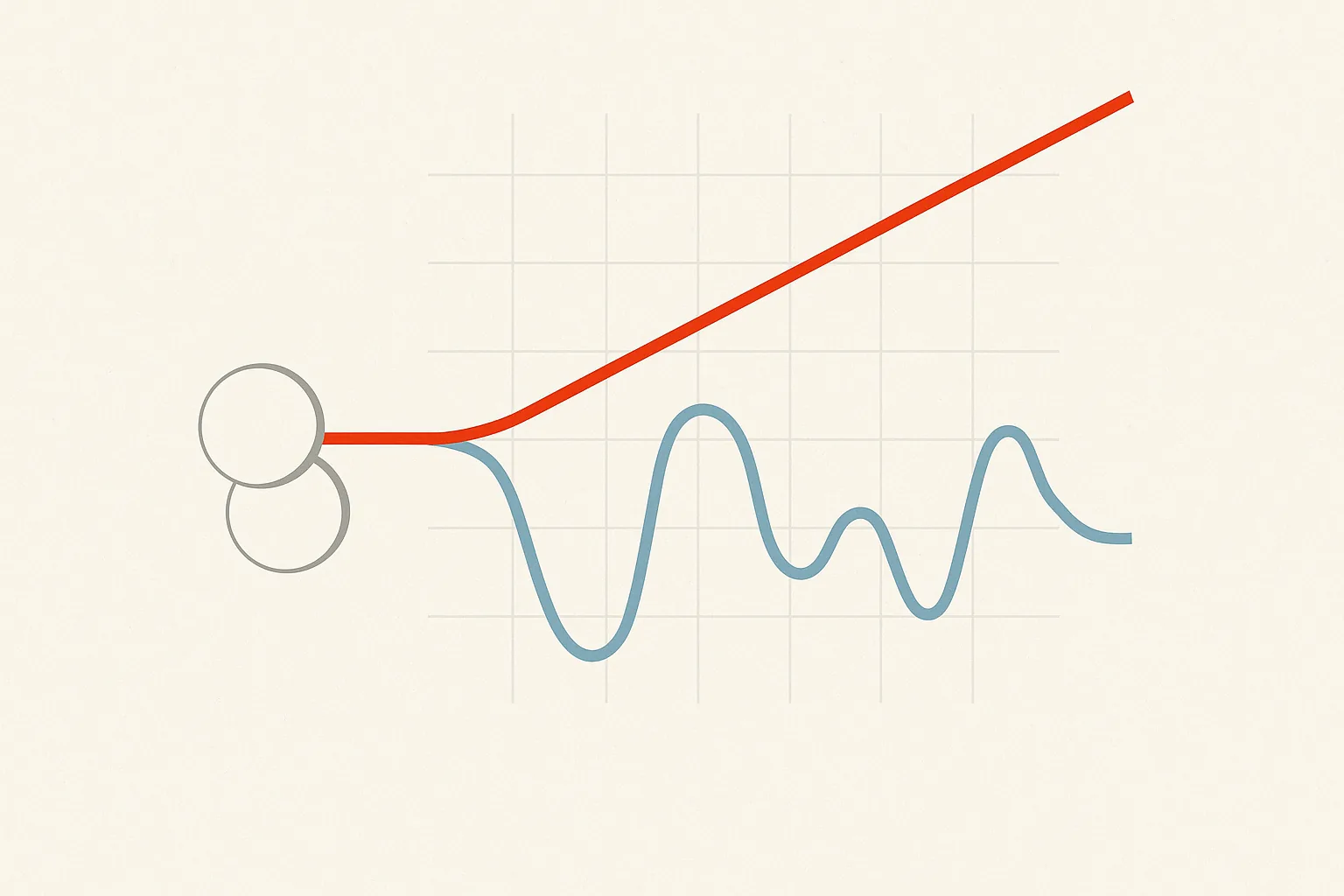
A EUR-denominated P2P loan advertising 8% looks better than a CHF loan advertising 5%. For a Swiss investor who spends francs, that comparison is incomplete. The advertised yield is a return in someone else’s currency. What lands in your Swiss bank account depends on the exchange rate on the day you convert, and that rate is not fixed. This article walks through how currency risk changes the real return, using illustrative numbers only.
None of the figures below are forecasts. They are arithmetic examples meant to show the mechanism, not a prediction of what CHF or EUR will do. If you are still building a general picture of how P2P lending works from Switzerland, read that first; this article assumes you already understand the basic mechanics and want to focus on the currency layer.
Currency risk basics for a CHF-based investor
If you live in Switzerland, hold francs, and eventually want to spend francs, then any loan denominated in a foreign currency carries two separate risks stacked on top of each other: the credit risk of the borrower or platform, and the currency risk of converting EUR back into CHF. These risks are independent. A EUR loan can perform exactly as promised in EUR terms, with every repayment arriving on schedule, and you can still end up with fewer francs than you expected, simply because the exchange rate moved against you between the day you invested and the day you converted the proceeds.
The reverse is also true. If EUR strengthens against CHF over your holding period, your francs-equivalent return improves beyond the quoted EUR yield. Currency risk is symmetric in theory. In practice, Swiss investors tend to worry more about the downside because of a long-run pattern discussed below.
A related point that is easy to miss: currency risk compounds with term length. A short 6-month EUR loan gives the exchange rate less time to move. A 3-year EUR loan gives it much more room to drift, in either direction. Matching currency exposure to the loan term is one of the simplest risk controls available, and it costs nothing beyond attention.
Why EUR yields look higher (and what that premium hides)
EUR-denominated consumer and SME loans on European crowdlending platforms often advertise higher headline rates than CHF loans on Swiss platforms. Several factors can explain part of the gap, and it is worth separating them before assuming the extra yield is free money.
- Different underlying credit markets. Consumer lending regulation, average borrower risk profiles, and enforcement mechanics vary by country, and these differences show up in the interest rate offered to lenders.
- A currency risk premium. Part of the extra yield can reflect compensation for the possibility that EUR weakens against CHF, not a genuinely higher risk-adjusted return once currency is accounted for.
- Platform and jurisdiction risk. A platform operating under the EU ECSP crowdfunding regime sits under different supervision than a Swiss platform, and Switzerland is not part of the EU, so EU passporting rules do not apply here. Different oversight is not automatically worse oversight, but it is different, and it deserves its own review under our P2P lending risk checklist.
- Liquidity and buyback structures. Some EUR platforms offer buyback guarantees or secondary markets that Swiss platforms may not, and vice versa. These features change the real risk profile independently of the headline rate.
The practical takeaway is not “EUR yields are fake.” It is that a EUR headline rate and a CHF headline rate are not measuring the same thing, and the gap between them is not pure profit. Some of it pays for currency exposure you may not want.
Scenario table: illustrative EUR loan outcomes in CHF terms
The table below is entirely illustrative. Assume, for illustration, an investor puts CHF 10,000 into a EUR-denominated loan, converted at the start, earning a quoted 8% over a 1-year term. We then apply three illustrative scenarios for how CHF could move against EUR over that year: no movement, a 3% CHF strengthening, a 5% CHF strengthening, and a 10% CHF strengthening. “CHF strengthens” means each EUR buys fewer CHF at the end than at the start, so converting EUR proceeds back to CHF yields less than the EUR-only math suggests.
| Scenario (illustrative) | EUR-side return | CHF appreciation vs EUR | Approx. effective CHF return |
|---|---|---|---|
| No currency movement | 8% | 0% | ~8% |
| Mild CHF strengthening | 8% | 3% | ~4.8% |
| Moderate CHF strengthening | 8% | 5% | ~2.6% |
| Sharp CHF strengthening | 8% | 10% | ~-2.8% |
The arithmetic behind the last two columns is straightforward. If CHF strengthens by X% against EUR over the term, each EUR you convert back buys roughly (1 – X%) as many francs as it would have at the start. A EUR-side return of 8% combined with a 5% CHF strengthening gives an approximate CHF-side return of (1.08 x 0.95) – 1, which is about 2.6%, not 8%. Push the strengthening to 10% and the same formula gives (1.08 x 0.90) – 1, which is roughly -2.8%: a loan that performed exactly as promised in EUR terms still lost money once converted back to francs. This is why currency risk is not a rounding error. It can erase most or all of a headline yield advantage, and in a sharp move it can turn a positive EUR return into a francs-equivalent loss.
Run the same numbers yourself with different assumptions before committing capital. Our risk screener includes a section for logging currency exposure alongside credit and platform risk, so the two do not get mixed together in your own notes.
Conversion fees and hidden spreads
The scenario table above assumes a clean conversion at the quoted mid-market exchange rate. Real conversions rarely work that way. Two costs sit between the advertised yield and what actually reaches your CHF account.
- Explicit conversion fees. Banks, brokers, and some platforms charge a stated percentage or fixed fee to convert EUR to CHF, taken on the way in, the way out, or both.
- Hidden spreads. Even where no explicit fee is shown, the exchange rate offered is frequently a few tenths of a percent worse than the mid-market rate you would see on a financial data page. This spread is a cost, even though nothing labelled “fee” appears on the statement.
Repeated conversions compound this cost. An investor who converts CHF to EUR to fund a loan, then converts EUR interest payments back to CHF every month, then eventually converts the EUR principal back to CHF at maturity, may pay the spread three or more times over the life of a single loan. Batching conversions, or choosing platforms that let you hold a EUR cash balance and convert less frequently, can reduce this drag. It is worth asking any platform, before investing, exactly which entity handles the conversion and what rate or fee schedule applies. This detail belongs in the same due-diligence pass covered in our methodology for reviewing platforms.
Practical rules for mixed-currency portfolios
A few habits reduce the chance that currency risk quietly overwhelms the credit return you actually signed up for.
- Check whether the quoted yield is EUR-side or already converted to CHF, and treat any comparison across currencies as approximate until you know which.
- Note that CHF has historically tended to be a relatively strong currency against EUR over long periods, though past patterns do not guarantee future movement and should never be treated as a forecast.
- Match currency exposure to term length where possible; shorter EUR-denominated commitments carry less exchange-rate uncertainty than multi-year ones.
- Separate credit risk from currency risk in your own notes so a good EUR platform is not judged only on a currency move it had no control over.
- Ask the platform directly which entity converts currency, at what rate, and how often, before funding a loan.
- Decide in advance whether you are comfortable holding EUR cash balances between conversions, or whether you prefer to convert on a fixed schedule regardless of the rate that day.
None of this means EUR loans should be avoided. It means the headline rate is only one input. A EUR loan at a higher quoted yield than a comparable CHF loan may still be the better choice for a given investor, but only after currency risk, conversion costs, and platform jurisdiction have all been weighed, not compared on rate alone.
Sources & status
Based on public guidance from FINMA (finma.ch) and the Swiss National Bank (snb.ch), and on the general structure of the EU ECSP crowdfunding regulation (note: Switzerland is not in the EU). All scenario figures and rates in this article are illustrative examples, not market data or forecasts. Last checked: 14 July 2026.
Educational content, not financial advice. Lending investments can lose all invested capital and are not bank deposits. Verify every platform claim yourself before investing.
Frequently asked questions
Is a EUR P2P yield comparable to a CHF yield?
Not directly. A EUR headline rate reflects EUR-side credit and platform risk only. To compare it with a CHF yield, you also need a view on currency movement and conversion costs over your holding period, since both can change what you actually receive in francs.
Does CHF always strengthen against EUR?
No. Exchange rates move in both directions over any given period. CHF has historically tended to be a relatively strong currency against EUR over long stretches, but this is a general historical pattern, not a rule, and it should not be treated as a guaranteed outcome for any specific investment term.
Can hedging remove currency risk from a EUR P2P loan?
Formal currency hedging tools exist for larger institutional amounts, but they are rarely practical or cost-effective for individual retail P2P positions. Most individual investors manage currency risk through position sizing, term matching, and diversification rather than hedging instruments.
Should I avoid EUR-denominated P2P loans entirely as a Swiss investor?
Not necessarily. EUR loans can still make sense as part of a diversified approach, provided the currency risk is understood, sized appropriately, and not mistaken for extra risk-free yield. The decision depends on your own tolerance for exchange-rate uncertainty, not on a blanket rule.